
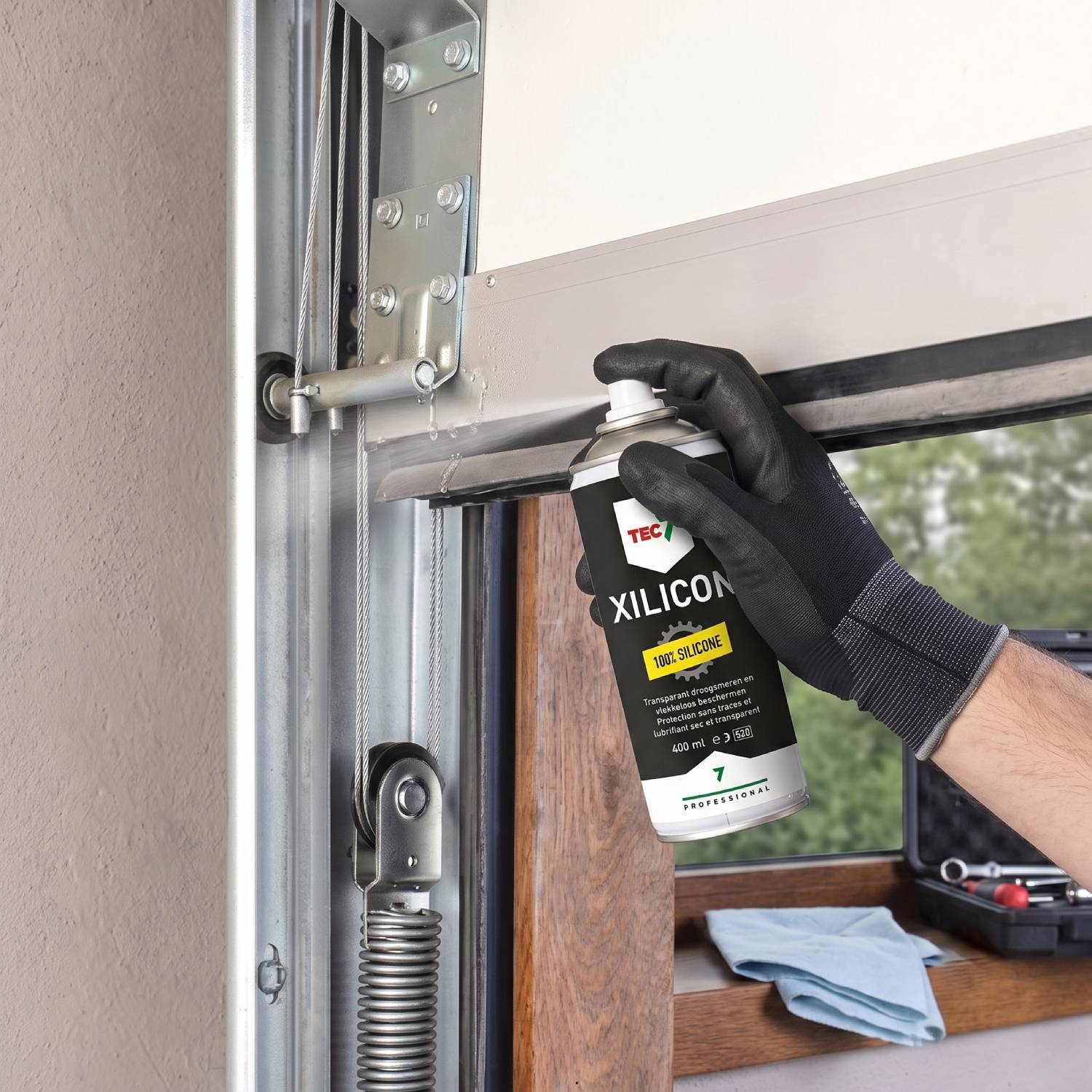
A residential garage door runs around 1,500 opening and closing cycles a year. Exposed to temperature swings, dust and humidity, its mechanics need regular attention. A few simple steps twice a year (ideally in spring and autumn) double the lifespan of your equipment and prevent more than 80% of breakdowns. This article deals exclusively with garage doors for private homes.
The golden rules of cleaning and lubrication
For the door leaf and panels: lukewarm water with a mild pH-neutral soap (Marseille soap, black soap or car shampoo) and a non-abrasive sponge. Pressure washers are strictly forbidden: the jet damages paintwork, flushes grease out of bearings and ruins the weather seals. When lubricating, the most common mistake is applying heavy grease or engine oil inside the tracks: the mix traps dust and sand and forms a hard paste that jams the rollers and strains the opener.
- Tracks must stay clean and dry — simply wipe them with a cloth.
- Use a silicone spray or a dry PTFE lubricant.
- Avoid harsh solvents, scouring pads and thick grease.
- The most important area to lubricate is the lower section, close to the ground: it is the most exposed to water and splashes, and therefore to rust.
The up-and-over overhead door
This classic tilting door swings outwards before sliding under the ceiling thanks to articulated arms and side tension springs. Visually inspect the springs and their fixings, then spray silicone or PTFE on the pivot points of the arms and on the guide roller bearings. A light coat of thin or anti-corrosion oil on the side springs prevents squeaks and rust.
The counterweight non-overhead tilting door
Very common for garages opening directly onto the street, it does not swing outwards during operation. Balance is provided by weights hanging in side boxes, connected to the door by steel cables and pulleys.
- Check the steel cables along the boxes: at the slightest frayed strand, do not touch them and call an installer.
- Make sure no object or debris obstructs the vertical travel of the counterweights.
- Degrease and lubricate with PTFE the telescopic arms, the transmission tube and the axles of the upper return pulleys.
The sectional door
Made of several articulated panels, the sectional door rises to the ceiling sliding through corner tracks. Repeated vibration loosens the screws of the assembly hinges: tightening them twice a year prevents mechanical play.
- Silicone on the axles of the metal hinges linking the panels.
- Lubricate the ball race of metal rollers — not full nylon rollers without bearings.
- Torsion spring above the lintel: clean it, then spray silicone to reduce friction between the coils.
The roller shutter garage door
This door coils into a top box using aluminium or PVC slats guided by side channels. Dust the inside of the vertical guides with a soft brush, then spray silicone directly into the rubber guide seals to keep the curtain gliding smoothly. In winter the bottom slat can freeze to the threshold: on a motorised door, always check it is not frozen before operating it, or you risk damaging the motor or tearing out the curtain fixings.
The opener and safety devices
An automated door brings great everyday comfort, but requires systematic safety tests.
- Chain drive: dry PTFE spray once a year, never heavy grease.
- Belt drive: clean the rail dry, once or twice a year — never oil or grease a belt.
- Photocells: dust the optics and test obstacle detection twice a year.
- Manual release: pull the emergency cord (red handle) once a year to check the door disengages during a power cut.
The mechanical reversal safety test
This test is essential to avoid any crushing risk (children, pets, vehicles).
- Place a wooden block about 5 cm thick flat on the floor, under the door's path.
- Start closing with your remote control.
- As soon as the door touches the wood, the motor must stop immediately and reverse upwards.
- If the door forces through or does not go back up, the motor force must be adjusted or checked.
DIY versus calling a professional
For your safety, it is essential to know the limits of home maintenance.
- Cleaning the structure, panels and weather seals.
- Wiping and dusting the tracks.
- Silicone/PTFE lubrication of hinges, axles, rollers and locks.
- Dusting the safety photocells and running the reversal tests.
- Springs (torsion or extension) and steel cables, under tensions of several hundred kilos.
- Realigning the balance tracks, which requires precision shimming.
- Complex reprogramming of the opener's electronic boards.
Warning signs that call for an inspection
Stop using the door and contact your installer if you notice any of these symptoms.
- A shrill metallic noise or heavy squealing on every operation.
- An unstable door mid-travel: disengaged and opened 1 metre above the floor, it must stay put. If it drops or rises by itself, the counterweights or springs are out of balance.
- A frayed steel cable, or a jerky / crooked movement.
By adding the cleaning and lubrication of your garage door to your spring and autumn routine, you guarantee quiet, safe and long-lasting operation. We also offer an annual maintenance contract for all brands, with fast intervention across the Brussels region.