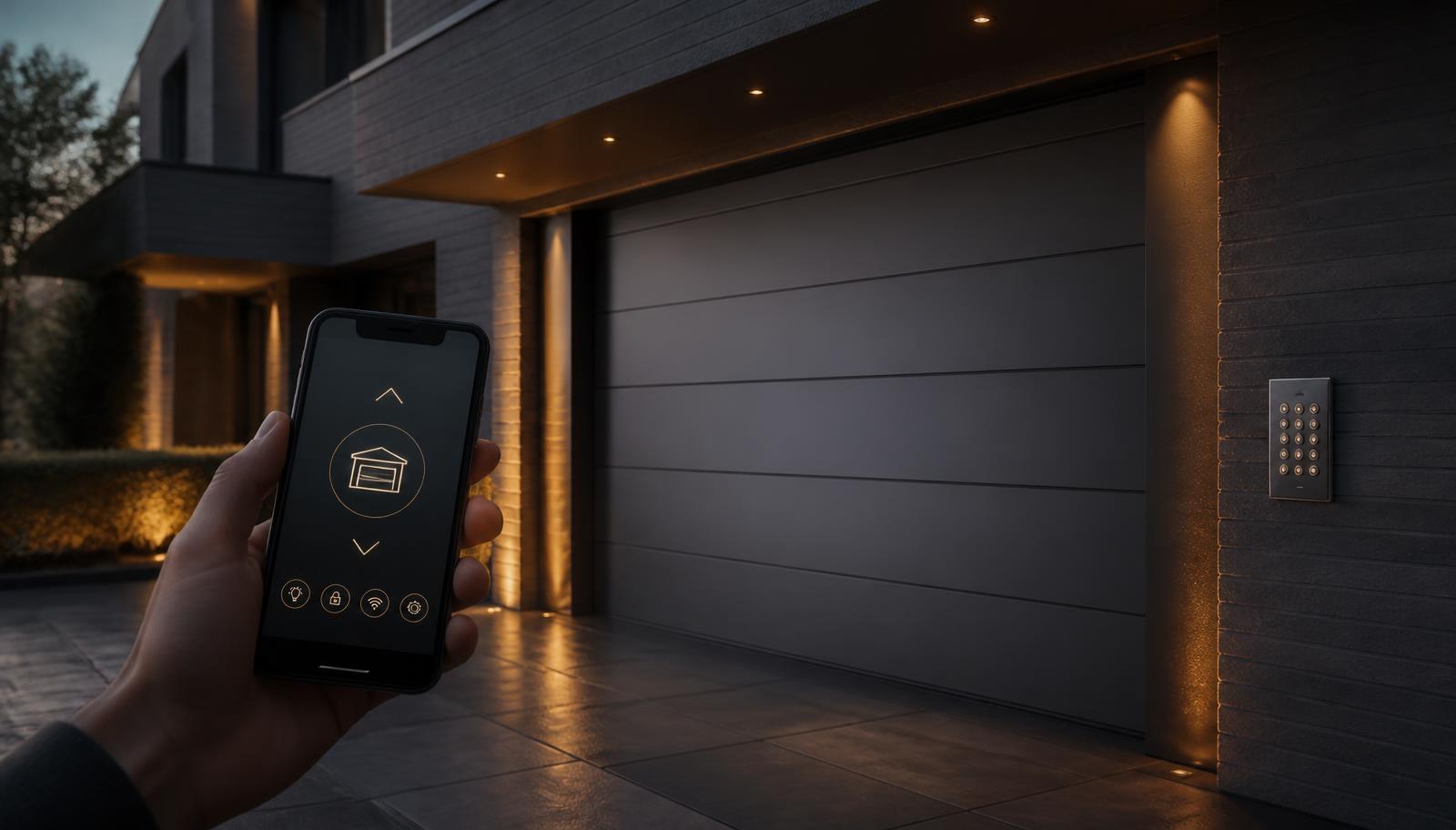
Residential closure engineering is going through a significant shift: the convergence of traditional mechanical protection and integration into the smart-home ecosystem. Operating a garage door from a smartphone, checking its status remotely or granting temporary access has become a common requirement. Yet a broader look at the market reveals major inconsistencies between the promises of connected hardware and the actual security of the access point.
The smart-home market: forced replacement and built-in obsolescence
In today's garage opener market, the vast majority of professional operators known for their mechanical robustness (such as the SEIP range) ship without any built-in Wi-Fi or IP network interface.
Note: SEIP is currently developing a new generation of motors that will natively integrate advanced smart-home features.
While waiting for these new motor heads to become widespread, and to meet the immediate demand for connectivity, many manufacturers push for a full replacement of existing motors with so-called "smart" opener heads running proprietary apps.
- Keeping a mechanically sound SEIP motor and grafting an open control module onto it.
- Preferring control electronics that can be replaced independently of the motor.
- Replacing a reliable motor purely to obtain a mobile app.
- Depending on a closed proprietary cloud whose shutdown makes the connected feature obsolete.
Confusing operational safety with intrusion resistance
A second market drift is the misleading equivalence drawn between operational safety and burglary resistance. Our previous article on choosing a garage door focuses on operating safety: finger-trap protection, spring safety devices and obstacle detection. Those mechanisms are essential to comply with European usage standards (EN 13241-1) and to prevent injuries. However, they offer no resistance at all against a burglar equipped with forcing tools: very few residential doors ship with genuine mechanical burglary certification (EN 1627).
Smart-home upgrade: integrating a connected module (e.g. Shelly Plus 1)
To connect an existing motor, we propose adding a dry-contact smart-home micromodule. The Shelly Plus 1 module is an excellent suggestion thanks to its reliability and affordable cost, but other equivalent solutions (other Wi-Fi, Zigbee or Z-Wave modules) can also be offered according to the user's preferences.
The logic boards fitted to the current SEIP motor range (TM60, TM70, TS75, TS100, TS130) work on the dry-contact principle: briefly bridging two terminals (a potential-free pulse) triggers the motor sequence (open, stop, close).
- Wired without injecting any external voltage: the integrity of the SEIP electronics is fully preserved.
- Control compatibility: existing wall buttons, key switches and remotes keep working exactly as before, in parallel.
- Power flexibility: powered either from 230 V AC or from the board's auxiliary 24 V DC supply.
- Pulse configuration: timer set (1.0 second) to replicate a push-button press precisely.
- Real-time status feedback: the exact position (door open / closed) available via a magnetic opening sensor connected to the module.
Outdoor Bluetooth access control: the CDVI Galeo system
For users who want to open the door from their car or on foot without going through the home Wi-Fi network, the CDVI Galeo system (GALEOBT model) is a professional-grade solution. The outdoor keypad, built from an ultra-resistant metal alloy (IP64/IP68 and IK10), contains no control components. The intelligent unit (BOXCODE controller) is installed inside the garage, in a protected area, and linked to the keypad by a shielded cable. If a vandal rips off or destroys the outdoor keypad, the door stays locked because the SEIP motor control relays remain sealed inside the building.
- Remote-electronics architecture: tamper resistant by design.
- Bluetooth Low Energy (BLE) chip: driven by the MyDigicode mobile app.
- Contactless opening: from the smartphone, within local range (~10 to 15 m).
- Access management: permanent or temporary keypad codes for visitors and contractors, managed directly from the app.
Burglary resistance: EN 1627 and resistance classes
On top of basic operating protections, the European standard EN 1627 (NBN EN 1627 in Belgium) rates building closures by their ability to delay a physical intrusion. Class RC2 is the minimum level recommended by crime-prevention experts for residential access points.
- RC1 / RC1N — no fixed attack time: casual opportunist, body force only (kicking, shouldering, lifting).
- RC2 — 3 minutes of sustained attack: equipped burglar with hand tools (heavy screwdrivers, pliers, wedges, small hammers).
- RC3 — 5 minutes of sustained attack: experienced burglar (crowbar, sledgehammer, carpenter's screwdriver, drill).
- RC4 to RC6 — 10 to 20 minutes of attack: professional intruder, powered tools (angle grinder, reciprocating saw, drill).
Bespoke RC2 non-protruding up-and-over doors by DoorSystems
To build a one-piece, made-to-measure up-and-over door that meets class RC2 requirements, DoorSystems applies a set of targeted mechanical reinforcements:
- Stiffened single-panel leaf: no independent sections that can be levered apart.
- Reinforced structure: frame and rails consolidated at the usual attack points (corners and lower area).
- High-security locking: deep-engagement side tilting bolts locking into the jambs.
- Inaccessible fixings: hinges and anchor points secured, not dismantlable from outside.
- Precision adjustment: perimeter clearances reduced to a minimum to prevent a forcing tool from being inserted.
Technology comparison and DoorSystems solutions
Each device serves a specific use case. We combine them rather than pitting them against each other:
- Connected module (e.g. Shelly Plus 1) — Wi-Fi/IP dry-contact pulse, remote access (Internet / Cloud), Wi-Fi encryption and galvanic isolation of the motor: offered option for remote smartphone opening and smart-home integration.
- CDVI Galeo + BOXCODE — Bluetooth Low Energy and keypad, local access (~10-15 m), vandal resistant (IP68/IK10, remote electronics): chosen solution for outdoor access control by code or smartphone.
- SEIP remote — rolling-code radio frequency, local access (~30-50 m), built-in protection against radio cloning: kept as the standard in-car control.
- EN 1627 class RC2 — single-panel leaf and tilting bolts, passive physical protection: certified 3-minute resistance against hand tools, manufacturing standard for our bespoke single-panel non-protruding up-and-over doors.
Rather than forcing expensive motor replacements or buying into the illusion of connectivity without physical protection, DoorSystems reconciles durability, comfort and security. By leveraging the proven robustness of SEIP motors — while keeping an eye on their upcoming innovations —, the flexibility of dry-contact smart-home modules (Shelly or other Wi-Fi/Bluetooth solutions) and the certified RC2 mechanical resistance of our bespoke single-panel non-protruding up-and-over doors, we deliver a complete and lasting answer for every project.